Prostir

Verified customer case

AI video editing with DaVinci Resolve

AI video editing with DaVinci Resolve, run by Claude or Codex on your own computer. Prostir hosts the agent that knows how to edit.

The case at a glance

Result

Live since 2 October 2026: it plans the cuts in DaVinci Resolve and checks the timeline for gaps and overlaps.

Who it's for

Creators making talking-head videos, tutorials, Shorts and Reels on Windows or macOS.

Topics

AI video editing with DaVinci Resolve · Claude Opus · ChatGPT / Codex · MCP · FFmpeg

01

Watch the workflow

  • The video shows the whole workflow. The steps below repeat it with your own footage.
  • A chat can suggest cuts. With this setup, the assistant also looks at your footage, works in Resolve and exports a file for you to review.
  • Keep your originals in a source folder, and make a separate project and output folder for this first try.
  • Before you ask for an edit, decide the audience, the length, the platform and what must stay in the story.
02

What the Video Editing agent does

On 2 October 2026 our Video Editing agent was live as v0.10. We checked 4 things: the public page, signed-in tool access, knowledge search and frame calculation. Prostir brings the editing know-how and checks, and your local Resolve connection makes the edit. We did not measure editing speed or final picture and sound quality.

Video Editing is our published Prostir agent for DaVinci Resolve. It adds editing knowledge, shot planning, timing math, speech-pace analysis, timeline checks and motion checks to your AI app.

Its MCP address sits behind OAuth sign-in. You keep your own model and your own editor.

Ask knowledge_search for a Resolve technique, editing_timing_calculator for frame-accurate durations, editing_timeline_audit for gaps and overlaps, or editing_speech_pace_analyze for pacing from word timings.

These tools check the data you give them. They do not open Resolve, watch footage, hear audio or judge whether a render looks good.

03

Install DaVinci Resolve on Windows

  • Download DaVinci Resolve Studio from Blackmagic Design, choose the Windows installer, unzip it and run the installer. Follow its driver and hardware requirements.
  • Launch and activate Studio, then create a test project. This guide uses the built-in MCP in Studio 21.1. The free edition or an older version may need a different setup.
  • Import a short clip into the Media Pool. Set the timeline resolution and frame rate first, for example 1080 × 1920 for a vertical Short or 1920 × 1080 for a landscape tutorial.
  • Match your real source and delivery needs. Save the project and keep a copy before you give an assistant edit access.

04

Turn on Computer Use

Use Claude Opus in a local Claude session, or a local Codex app with your ChatGPT account. The app must support local tools.

Turn on Computer Use as well as MCP. The assistant can then see Resolve's own screens and use controls the tool list lacks.

In Claude Desktop, open Settings → General → Computer use, turn it on and approve DaVinci Resolve. It depends on your plan and system. On macOS, also allow Accessibility and Screen Recording.

In Codex, turn on a compatible local Computer Use integration and its system permissions.

Ask the assistant to show the open Resolve project before you allow changes. ChatGPT in a browser cannot reach your desktop, even with an MCP address.

05

Connect Resolve to your AI app

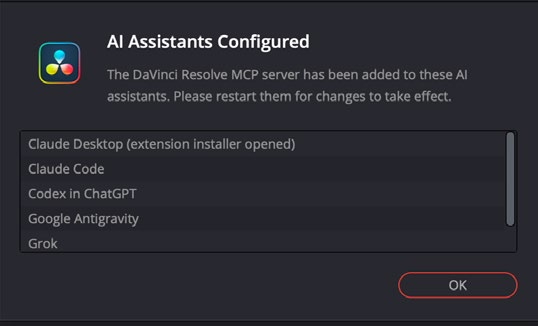
Install your AI app first. Then open Resolve Studio 21.1, choose File → Setup AI Assistants… and wait for AI Assistants Configured.

This sets up Resolve's built-in MCP for the apps it finds. If the Claude Desktop extension installer opens, finish it. Restart the listed apps so they load the connection.

In a new session, ask the assistant to list its Resolve tools and read the current project and timeline without changing them.

The confirmation below is from the official 21.1 manual, page 4318, so your screen may differ. If your app is missing, check the current manual and app settings instead of guessing a file path.

DaVinci Resolve confirmation listing the AI assistants configured for its local MCP server
The setup confirmation from the official manual. Your language and listed apps may differ. Blackmagic Design manual, page 4318

06

Connect the Prostir Video Editing agent

Add a second connection for our agent: https://video-editing.ai.prostir.build/mcp.

In Claude, use Settings → Connectors → Add custom connector and finish the OAuth sign-in. In Codex, the commands below add the address and start sign-in. Labels and access to custom connectors can vary by plan.

Keep both connections on while you edit. Resolve does the editing on your computer, and Prostir supplies the editing knowledge and checks.

Test the agent with a knowledge_search request and look at its tool list. If sign-in fails, finish the OAuth flow it offers. Never paste an account password into a prompt.

Codex: connect and sign in

codex mcp add video-editing --url https://video-editing.ai.prostir.build/mcp
codex mcp login video-editing

07

Install the FFmpeg skill from GitHub

The kajisho5/ffmpeg-skill repository gives your local assistant ready media tasks: probe, trim, crop, captions, audio, export and checks. It handles file prep and delivery around Resolve.

A Skill adds instructions and scripts. It does not add a second model or a remote editor.

Install Node.js for npx, Python 3.9 or newer, and FFmpeg 5 or newer with ffprobe. On Windows, run winget install Gyan.FFmpeg and reopen the terminal.

Install the Skill for Claude Code or Codex with the commands below, then run doctor. Check each result, because captions may need libass.

The scripts run on your computer. Speech-transcription models are a separate, optional install.

Windows: install FFmpeg

winget install Gyan.FFmpeg

macOS: install FFmpeg

brew install ffmpeg-full

Claude Code

npx ffmpeg-skill

Codex

npx ffmpeg-skill --codex

Install for your local assistant

npx ffmpeg-skill doctor
npx ffmpeg-skill contract --json

08

Make your first edit

  • Start with a 60–90 second talking-head clip and ask for a 30-second vertical draft.
  • Give the assistant the exact source folder, output folder, message and anything to leave out.
  • Ask it to inspect the clip and report the frame rate, audio tracks, transcript and proposed cuts before it edits.
  • Once you accept the plan, it makes a new timeline, places the chosen parts, adds B-roll and captions where they help, and exports a review file. Make your changes in that draft.
  • The prompt below gives the assistant this order of work.

A prompt for your first review cut

Use the Prostir Video Editing agent and my local DaVinci Resolve connection. Inspect the open project and source clip first. Propose a 30-second 9:16 edit with a clear hook, accurate captions and an intact ending. Wait for my approval of the plan. Create a new review timeline, preserve the original, export to my output folder, then inspect the render and tell me what still needs visual or audio review.

09

Shape the story, captions and pace

  • A short video needs a clear opening, one complete point and a deliberate ending.
  • Cut dead setup, but keep breaths, emphasis and whole sentences.
  • Pace analysis needs a transcript with real word timings. Without them, ask for a transcript or check the speech yourself.
  • Caption meaningful phrases, check reading speed and keep text clear of platform buttons. Use B-roll where it explains a point.
  • For Fusion titles, keep graphics on their own tracks. Check the first frame, the animation, the hold and the exit in the actual render.
  • Frame math and motion checks help your review. You still need to watch and listen.

10

Check and export files with FFmpeg

Ask the FFmpeg skill to probe files, try a crop or trim as a dry run and export a platform preset to a separate file.

On Windows, the sample uses PowerShell and the Codex install under $HOME/.agents/skills. Claude Code installs under $HOME/.claude/skills. On macOS, use python3 if that is your Python command.

The example probes input.mp4, previews a 9:16 crop, exports the Reels preset and checks the named result. Replace input.mp4 and export.mp4 with your own paths, and check the output name the export reports.

Then look at the rendered file, a contact sheet and the audio. A contact sheet cannot show missing syllables, pops, silence or bad sync.

PowerShell: inspect, preview, export, check

python "$HOME/.agents/skills/ffmpeg-skill/scripts/probe.py" input.mp4 --compact
python "$HOME/.agents/skills/ffmpeg-skill/scripts/fit.py" input.mp4 --aspect 9:16 --fit crop --dry-run
python "$HOME/.agents/skills/ffmpeg-skill/scripts/export.py" input.mp4 --preset reels --json
python "$HOME/.agents/skills/ffmpeg-skill/scripts/check.py" export.mp4 --platform reels
python "$HOME/.agents/skills/ffmpeg-skill/scripts/look.py" export.mp4

11

Fix common setup problems

  • If the Setup AI Assistants menu is missing, confirm you have Studio, check the version and read the current Blackmagic manual.
  • If no Resolve tools appear after setup, restart the app, check which apps the confirmation listed and try a read-only project query.
  • On Windows, use a local session that sees the same media paths as Resolve. A WSL path is not automatically a Windows path.
  • If the agent plans but cannot cut, check the local Resolve connection separately from the Prostir connection.
  • If a control is missing from MCP, use Computer Use to see and operate the editor, then check the result.
  • If doctor reports missing filters or a clip is offline, fix that dependency or media path before you run the edit again.

12

Questions and when the edit is done

  • Can I use the free edition of Resolve? This setup is documented for Studio 21.1. Don't assume the free edition works the same way.
  • Do I need the FFmpeg skill for every cut? No. It helps with prep, file checks and delivery.
  • Does the Prostir agent replace Opus or ChatGPT? No. It adds knowledge and tools to the model in your app.
  • When is the edit finished? When you have watched the export end to end, listened to every cut, checked captions and sync, and confirmed length, size, frame rate and audio.
  • What should I keep? Save the project, export settings and final file together. You decide whether the edit tells the story.

Solutions

Build your agent from one prompt

Start with one customer question or routine task. Builder sets up the agent with your files and the actions you allow, and Prostir hosts and runs it.

Image preview