Prostir

Research-backed article

What is an AI-native Store?

AI-native Store means more than a storefront generated from a prompt. It is a commerce system whose approved catalog, inventory, cart, checkout, order, and customer capabilities can be understood and used by an authorized AI through bounded tools, while money and authority stay under deterministic rules.

Before you read

What gets published

A practical test for separating an AI store builder from an AI-operable Store, plus a safe way to decide what should be customized, what must remain deterministic, and where Prostir Store fits today.

Best for

Store owners, ecommerce teams, and operators whose real advantage lives in unusual product, approval, fulfillment, service, or customer workflows that a generic template does not model well.

Where the work happens

AI-native Store · AI ecommerce · MCP · Custom commerce

01

The thirty-second answer

AI-native Store means a commerce system an authorized AI can understand and operate through bounded tools, not merely a storefront generated from a prompt. The test is operational: can the AI read the right catalog or order context, propose or perform one allowed action, explain what changed, and stop when identity, permission, confirmation, or product rules say no? If the AI only writes descriptions or changes a theme, it is useful AI assistance, but it is not yet the operating boundary of the Store.
02

A generated storefront is only the visible layer

An AI store builder can produce a polished theme, page structure, copy, and images quickly. That solves the visible starting layer. The business begins underneath it: variants, regional payments, wholesale approval, split fulfillment, pickup windows, stock conflicts, returns, customer consent, and the odd order that never matches a demo. A beautiful generic Store may still force people into spreadsheets and manual workarounds because the real process was never represented. AI-native design starts by giving those rules explicit data and actions instead of hiding them inside prompts.

03

Start with the exception your business owns

Do not customize everything because AI can write code. Write down the one exception customers or staff handle repeatedly, its trigger, required data, owner, allowed outcomes, and failure cost. Then decide whether it belongs in configuration, a tested tool, an integration with the current system of record, or a human approval step. The value is not a promise of one hundred percent automatic fit. It is the ability to shape and test a bounded process against your business without rebuilding the transaction core for every idea.

04

What Codex, ChatGPT, or Copilot can actually do

A compatible AI client can work through typed Store tools where its plan, transport, authentication, and permission rules support MCP. Codex can help inspect contracts, implement and test a connector or JavaScript tool, and call approved MCP capabilities. ChatGPT can use reviewed remote MCP actions on supported plans, while GitHub Copilot surfaces vary by product and configuration. None of them should receive database credentials or unlimited commerce authority. The Store service remains responsible for validation, revisions, confirmation, audit, and refusal.

05

Money and authority stay deterministic

Catalog facts, inventory changes, cart totals, checkout creation, order state, payment-provider calls, refunds, and access changes cannot depend on a model improvising a plausible answer. AI may translate intent, gather missing inputs, explain options, or propose a next action. Typed rules decide whether that action is valid; the authoritative Store or connected backend commits it; consequential actions keep confirmation and an actor trail. This is what lets customization grow without turning every prompt into a new financial or security boundary.

06

How Store, CRM, ERP, and project work fit together

A Store should coexist with the systems that already own customer relationships, finance, inventory, fulfillment, and team delivery. An AI-native layer can connect to a CRM, ERP, or project-management system through the minimum approved actions instead of copying all their data into a second truth. In Prostir, Store is the commerce product. Team already provides shared Tasks, Goals, Data, Files, and Knowledge for collaborative work; deeper CRM and Operations or ERP-oriented modules are planned, not completed standalone products. The boundary matters more than an all-in-one label.

07

Where Prostir Store fits today

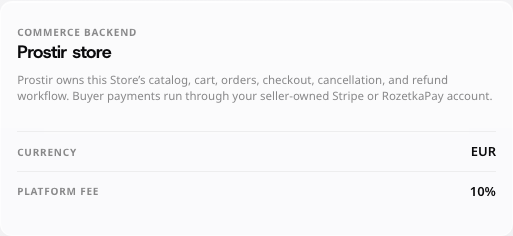
Prostir Store is in Preview. Its native foundation covers typed catalog, variants, inventory, a one-Store cart, checkout and order state, fees, and Store-scoped customers; a capability-gated connected backend may remain authoritative for commerce operations. Owner-authorized Studio MCP tools can manage bounded Store configuration without exposing provider secrets. An existing Agent remains the separate buyer-facing AI interface. Choose a mature platform today when you need broad proven commerce operations; discuss a Prostir pilot when one exact, authorized AI workflow is the differentiator you need to test.

Solutions

AI ecommerce platform preview built around seller authority

Keep the Store as the commerce owner, keep the Agent as the AI product, and connect them through an exact grant so buyer conversations stay inside one seller and one Store boundary.

Solutions

Evaluate one honest buyer journey

Bring the Store, catalog source, seller checkout, and buyer questions. We will scope what the implemented foundation supports and label preview gaps before implementation.